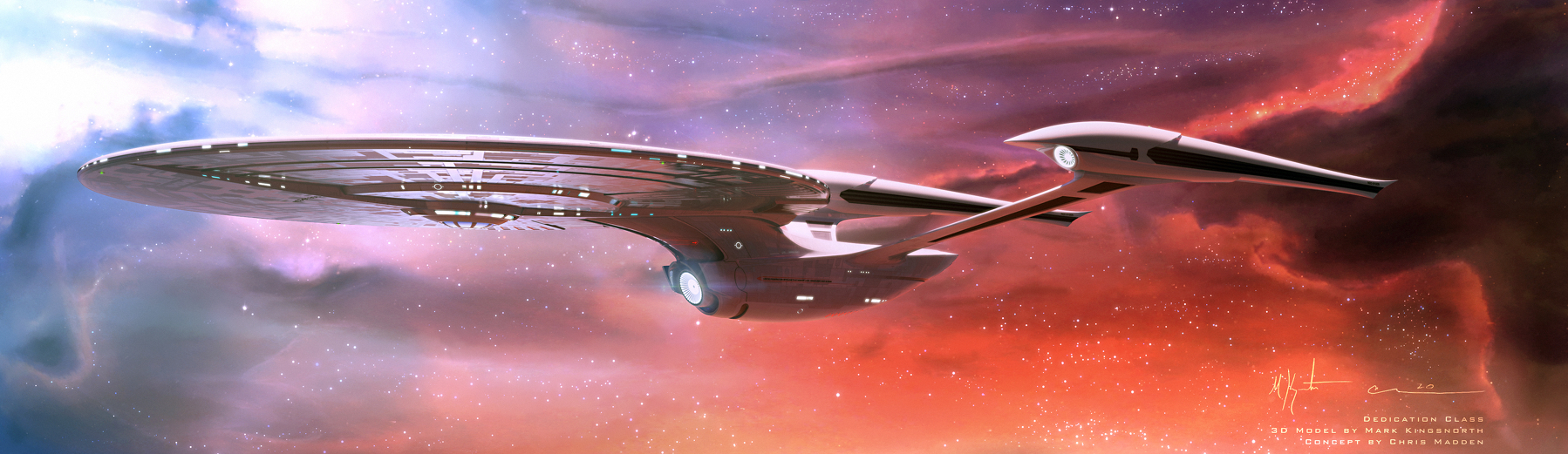
There was a stretch in the 90s when I could turn on the television at five in the afternoon and land in the middle of an hour of Star Trek. It could be The Next Generation or Deep Space Nine or even Voyager. No idea which season. No idea what happened last week. It didn’t matter. Somebody had a problem, the problem got worse, and 44 minutes later it was mostly solved, and everybody went back to work.
That’s the version I keep thinking about, because it’s the version of Star Trek I want and I think it’s the version a vast majority of fans want.
Star Trek turns 60 next month. Starfleet Academy was canceled in March. Strange New Worlds gets 6 more episodes in 2027, then it’s finished, and after that there will be no Star Trek on television for the first time since 2017. Somebody is going to get to build the next one. It might be a while, but somebody will.
So here’s what I’d hand them.
Start clean. No prequel. No legacy character. Nobody’s foster sister, nobody’s younger self, no cameo in the last act of the pilot to get people posting. The last decade of Star Trek has been built almost entirely on recognition, and the returns on that investment are now visible. Clean doesn’t mean a reboot. It means a show that owes nothing to a fan wiki.
The only requirement for a show called Star Trek is that it takes place aboard a ship named Enterprise in the far future, where the crew has science-fiction adventures. Warp drive, transporters, phasers. That’s the whole contract. It has to be about trekking to the stars, which means exploration, learning, and social commentary dressed up as adventure for kids and for the overgrown kids who never stopped watching.
And call it Star Trek. Nothing after the colon. Yes, I put a joke about a 1987 title at the top of this thing, and that’s the whole disease in one headline. Every name since 2017 comes with a handle attached, a ship you’re told to care about or a man you already miss. They released the 2009 movie without subtitles, and nobody got lost.
Set it in 2430. I’m not asking anybody to throw out the timeline. Keep all 60 years of it exactly where it sits.
Picard left off in 2401. Give it a generation. That’s far enough that the people we just spent three seasons saying goodbye to are gone, and close enough that the Federation still looks like the Federation. Then push the ship out past the edge of charted space with orders to keep going. Nobody the audience recognizes is alive. There’s no admiral six hours away by subspace waiting to give a speech. Every planet is a first contact, and every week the crew is the least experienced species in the room.
Star Trek has done exactly this three times. The Next Generation skipped 80 years ahead and put strangers in the chairs. Deep Space Nine parked us at a station nobody had heard of. Voyager threw its crew 70,000 light years out on purpose. All three kept the Federation, and the Prime Directive and the belief that we get better, and all three left the old furniture in the old rooms. That’s not a reboot. That’s how this thing has always renewed itself, and we quit doing it in 2017.
Let’s add a small mystery. In the second episode, they find something on a dead moon they can’t account for, log it, and move on. In the sixth, they find another one, 40 light years away. One lieutenant notices.
That’s the fear underneath the whole show, and it’s the one everybody watching already lives with. We’re small, the news is bad, and we’re going anyway.
Twenty-two episodes. This is the part that will get me arguments.
A 10-episode season is a movie cut into pieces. Everything is an arc. Nothing is an hour. There’s no room for the bottle show, or the courtroom show, or the one where a junior officer we’ve barely met turns out to be the best character on the ship. All the great Star Trek I can name was somebody’s weird standalone. “The Measure of a Man.” “The Inner Light.” “The Visitor.” None of those are season plots. They’re hours.
You need volume to get hours like that. You need a schedule that forces the staff to take swings, because 22 slots a year means some of them have to be strange. And 22 means something else, which I’ll get to.
Then hide a Bad Wolf in it. In 2005, Russell T. Davies brought back Doctor Who with Christopher Eccleston and 13 mostly standalone episodes. Two words kept turning up in the background. Graffiti on a wall. A Welsh phrase on a sign. The name of a television channel. Bad Wolf. If you weren’t paying attention you never noticed, and you still got a complete story every week. If you were paying attention, you spent three months quietly losing your mind, and the finale paid you back.
Do that with the thing on the dead moon. Twenty-two hours of exploration, and buried in maybe 9 of them, a shape that shouldn’t be there twice.
That’s the compromise that makes 22 episodes work in 2026. The audience gets a show they can drop into cold at 8:00 on a Tuesday. The people who watch every frame get a thread. Nobody has homework. Everybody gets rewarded.
The thing that actually decides whether any of this is good. Twenty-two hours a year is more than a room of eight writers can produce without repeating themselves. That’s a feature. It means you have to go outside.
Star Trek used to do this on purpose. The original series went looking for working science fiction writers and got Theodore Sturgeon and Harlan Ellison and Jerome Bixby, people who wrote prose for a living and came in with a single idea. Then, in 1989, Michael Piller opened submissions for The Next Generation to anyone. No agent, no credits. Thousands of scripts came in each year. Ronald D. Moore was 25 with nothing on his resume when his script came out of that pile, and he stayed ten years and wrote “The Bonding” and “Tapestry.” Bryan Fuller got in the same way, with a spec that was rejected before it was bought.
That door closed around 2001, and nothing replaced it. Now Star Trek gets written by professional television writers, hired the same way every show is nowadays. They’re skilled. They also grew up on television, and it shows. Strange New Worlds did its musical episode 22 years after Buffy did one, and it did a puppet episode a few days ago, 22 years after Angel turned its lead into a puppet.
Reopen the door. Buy four scripts a season from people nobody has heard of before. Put a novelist in the room who has never written for television and let them be confused about how a teaser works.
One more thing, and this one is just for me. I want a first contact specialist on that ship who’s a genuine obsessive about the early 21st century. Out of regs, Chuck Taylors, a working Walkman, movie posters from 2001 on the wall of an office in the 25th century. Partly because it’s funny. Mostly because a show about us needs somebody aboard whose entire job is us.
Sixty years is a long time to keep a thing alive. Give it 22 hours a year, an open door, and something in the background nobody can quite explain yet.
Be seeing you.