
The plan was all too simple, which usually means it was a bad one.
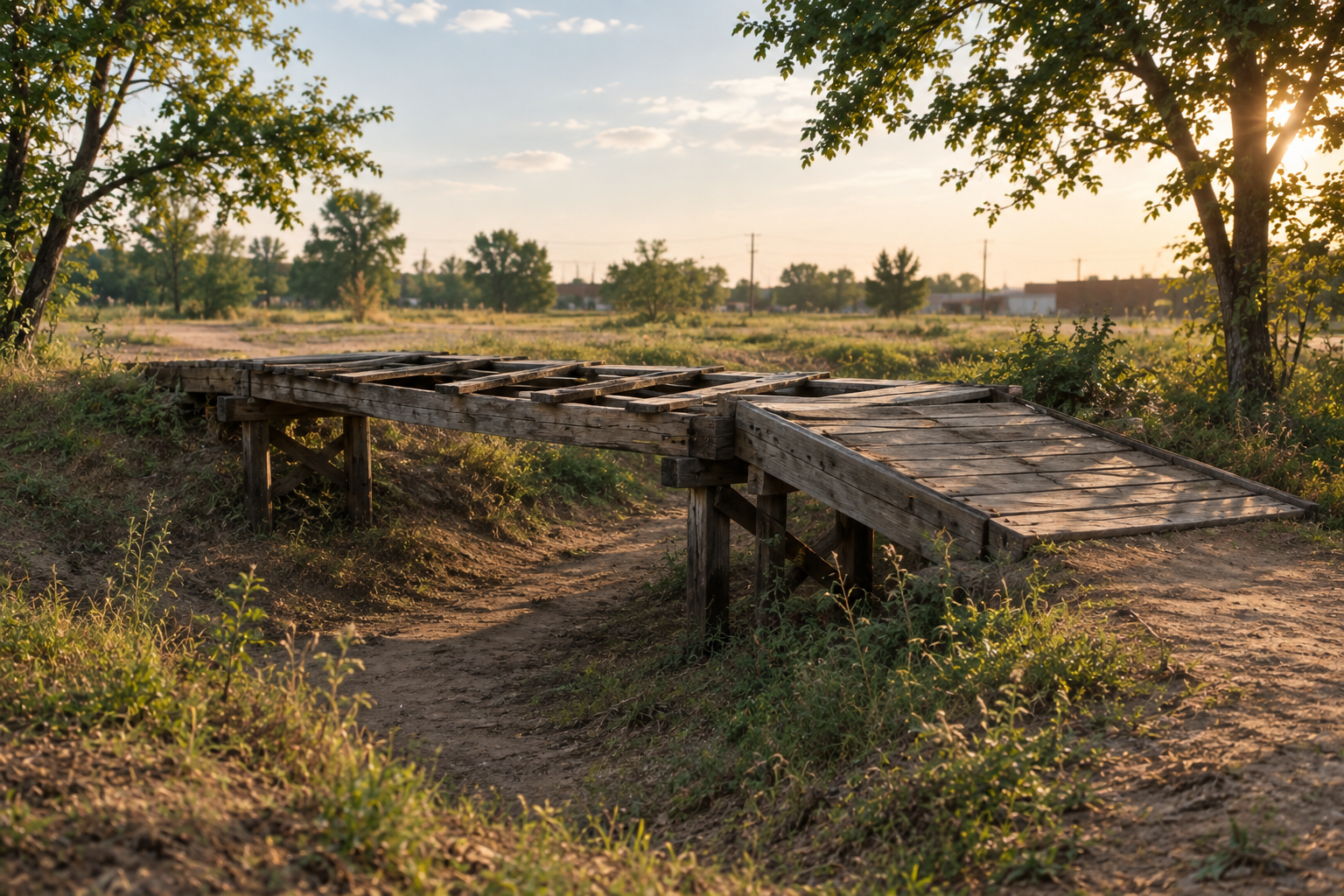
Baker’s Bridge had a spot where the planks were missing, and the ground dropped away underneath it. You could maybe walk over it, but you certainly couldn’t ride your bike over it without your front tire getting stuck. It didn’t matter because we were never going over the bridge.
The goal was to jump the corner. We’d come at that corner fast enough on a bike, and get serious air. That was the entire appeal. Not distance, not style. Height. We wanted to know who could get highest off that corner, and the only way to settle it was to go.
Then somebody said we should do it back to back to back. No gap. Three of us, one after another, close enough that we looked like one long train.
I was second.
We always started on the street to build speed. We jumped the curb and landed on the grass, down a sloping dirt path between the houses, and hit the bridge. The first kid, Mike, went off the corner and something went wrong in the air. I was already committed by then. I remember the precise moment I understood I was going to hit him, and I remember that understanding it did not help even slightly. I caught his back wheel, and we went down together into the dry creek bed, which had never really had water running through it and was mostly patchy brown grass and bare dirt.
The third guy, Jeff, came off the corner a half second later, saw the whole situation laid out below him, and somehow threaded the gap between us.
He won. Nobody ever said so out loud, but he won.
Nothing broke. You’d think someone might have broken an arm or a wrist. Nope. Maybe some skin off an elbow and a knee. Mike’s bike needed some wheel work. The only real casualty was pride, and pride heals on its own schedule without anybody’s help.
We didn’t tell anyone.
Not because we’d have been in trouble, though we probably would have been. It just wasn’t a thing you did. You didn’t bring that home. You handled it at the creek, walked the bikes back, cleaned yourself up in the driveway before dinner, and went back the next day. Telling a parent would have changed the terms of something, and all three of us understood the terms without ever once discussing them.
I couldn’t tell you the year, and I could only guess at the month when all of this happened.
The bridge was one stop on a map that existed only for us. There were other points. The woods were down the road and across a fairly busy Evergreen Avenue. That set of woods had a real creek that had water in it some of the year and not the rest. We’d splash around in it all summer, come home soaked from head to toe, and strip in the garage before putting on fresh clothes for dinner.
On the other side of Baker’s Bridge there was an empty lot where we played baseball in the summer, with bases we made out of cardboard and rocks and ground rules about ghost runners and home runs that everybody understood.
I remember choosing sides by hand over hand. One captain tossed the bat straight up, handle first, and the other caught it one-handed. Then came the climb, fist over fist up the handle, each of us squeezing in above the other’s grip until there was hardly any wood left. The last one who could hold on, or even just palm the knob and keep it there, won first pick of players or first turn at bat. Nobody argued.
Look at that list for a second. A bridge that was falling apart. A creek that was dry half the time. A lot with nothing on it.
Every single place that mattered to us was a place nobody else had figured out what to do with yet.
Most of the time, the kids in the neighborhood didn’t have a park we could hang out at. There weren’t any playsets or walking paths.
We had the leftovers. Places in our neighborhood were waiting on a purpose, and until the purpose showed up, it was ours. I’m not complaining. It’s closer to the opposite. Nobody assigned us that bridge, and nobody could take it away either, because you can’t take away something you were never using.
Today, there’s a park with a playset and a walking path near the woods where we played. The lot has three houses on it now. Baker’s Bridge is long gone.
I could make that sound like a loss. It would be easy. But I bet there are kids in those houses, or there were, and one of them has a spot in the backyard that means something to him the way that empty lot meant something to me. That’s what was always going to happen.
What I lost isn’t the lot. It’s that I was eleven or twelve and the whole neighborhood was unclaimed, and now I’m old enough that everything I drive past or look at on Google Street View belongs to somebody else.
The bridge taught me something the lot couldn’t, though.
I hit the ground hard that afternoon, got up, and made a decision that nobody supervised or reviewed. I decided I was fine. I was the only one in a position to make that call, and I made it, and I turned out to be right.
That’s a strange kind of education. I’m not going to argue it was better or worse. Some kid somewhere made that same call and was wrong, and I know how that story ends. But I got a version of childhood where the adults weren’t watching, and I found out what I could handle by handling it.
A tiny scar runs along my left arm. Small, faded, nothing anybody would notice. I know exactly where it came from, and I’m one of maybe three people alive who do.
I spent time with Jeff recently, and we reminisced about Baker’s Bridge, getting soaked at the creek, building snow forts and treehouses. Climbing fences and trees.
We were young, wild, and free. I can close my eyes and remember. What a time to be alive.
Be seeing you.
Liked this one?
There's a new essay every Saturday, and shorter notes during the week. If you want another one now, start here. Or I can send it Sunday morning along with whatever piled up. Same writing, less remembering.
Porch light's on either way.